
On this day (1070): Roquefort cheese created in a cave near Roquefort, France,
Cooperate. From my OED app: “/kəʊˈɒpəreɪt / (also co-operate) ▸ verb [no object] work jointly towards the same end: the leaders promised to cooperate in ending the civil war staff need to cooperate with each other. ▪ assist someone or comply with their requests: his captor threatened to kill him if he didn’t cooperate. – ORIGIN late 16th century: from ecclesiastical Latin cooperat- ‘worked together’, from the verb cooperari, from co- ‘together’ + operari ‘to work’.”
“Lawmakers quarrel over effort to boost defense tech integration between US and Israel” [Military Times]. “The United States-Israel Defense Technology Cooperation Initiative, part of the House’s edition of the National Defense Authorization Act released last week, would “expand and accelerate bilateral defense technology research, development, testing, evaluation, integration, and industrial cooperation,” according to the bill.” This is section 224. More: “[Thomas Massie, R-Ky.], who recently lost his Republican primary to a challenger closely aligned with President Donald Trump — and his administration’s position on Israel — said in a message on social media, ‘If the provision in the NDAA to integrate/synchronize the U.S. and Israeli militaries (section 224) makes it out of committee, I’ll offer an amendment to strip it from the bill on the floor.’ Massie appeared concerned that such a level of integration would infringe on U.S. sovereignty.” And: “’[Rep. Mike Rogers, R-Ala.] defended the measure Tuesday, posting on social media that it ‘In no way does it give away command and control of our military operations, personnel, or equipment.’” • Maybe because our lost sovereignty is a fait accompli? Already happened?
“Israeli study finds starvation in Gaza was result of deliberate policy” [Middle East Eye]. “In May 2024, following US pressure after the Israeli assault on Rafah, Israel allowed a greater number of commercial trucks into Gaza, while simultaneously restricting humanitarian convoys. Last month, Walla reported that 11 Israeli supermarket chains generated hundreds of millions of shekels in revenue after winning an exclusive tender to supply food and aid to Gaza. [Shmuel Lederman, an Israeli scholar specialising in genocide studies] told MEE that the privatisation of aid delivery contributed to ‘the creation of a monopoly that makes it possible to generate large profits’. He added that this ‘worsened the humanitarian situation in Gaza’, enabling a small number of actors to profit ‘often in cooperation with Israel, while the vast majority of the population suffers.’” • Ka-ching (although I think I would use the word “collusion,” rather than “cooperation”).
“Four Numbers Aren’t a Dilemma” [Math of Politics]. The first paragraph: “A new paper by Alexandre Morozov and Alexander Feigel in PNAS offers a genuinely interesting evolutionary result. If each player in a population of Prisoner’s Dilemma agents carries an opponent-indexed cooperation probability — 𝑝𝑐,𝑖→𝑗, one entry per partner identity — then selection and mutation routinely produce cooperative configurations. The press release framed this as resolving the Prisoner’s Dilemma after seventy-five years of pessimism. The paper itself is more careful, and the careful version is the one worth looking at, because it makes visible a distinction formal theorists rarely state out loud.” And the last: “The right way to read Morozov and Feigel is in this light. The result is real, the mathematics is beautiful, and the generalized Fisher theorem deserves a wider audience than it has had. The thing they show is genuinely worth showing — opponent-conditioning produces cooperative outcomes under selection without explicit tit-for-tat designed in. But whether what they have studied is the Prisoner’s Dilemma, or a richer game in which the prisoners have been issued Schelling’s toolkit and asked to bargain, is a question worth asking with care.” • Sounds important, but maybe a reader more mathematically literate than I am — that is not hard! — could expound?
Dad Joke of the Day: I bought a wooden car the other day. Wooden start.
Punctuate. From my OED app: “/ˈpʌŋ(k)tʃʊeɪt / ▸ verb [with object] 1 insert punctuation marks in (text): they should be shown how to set out and punctuate direct speech [no object] style manuals tell you how to punctuate. 2 occur at intervals throughout (an area or period): the country’s history has been punctuated by coups. ▪ (punctuate something with) interrupt or intersperse something with: she punctuates her conversation with snatches of song. – ORIGIN mid 17th century (in the sense ‘point out’): from medieval Latin punctuat- ‘brought to a point’, from the verb punctuare, from punctum ‘a point’.”
“How Olga Fröbe-Kapteyn—a Painter, Collector, and Collaborator of Carl Jung—Mined the Archive and Her Subconscious’ [Art in America] “Like many early abstract artists, such as the Swedish painter Hilma af Klint, Fröbe-Kapteyn did not consider her work ‘art,’ but rather something touched by a higher power. Her works were made entirely in primary colors, plus black and gold. Their harsh geometric forms are sometimes punctuated by recognizable symbols like crosses and hearts, while others are made entirely of abstract twisting, circular, and diagonal forms. Her works were meant to be irrational—unlike the archetypes she collected, which had specific, if complex, meanings. The drawings and prints she made were not intended to be decoded. They existed outside language, in a world she thought of as her unconscious as she strove to work free of intention; other artists working in similar ways, like Klint, might call it the spirit world.” For example:
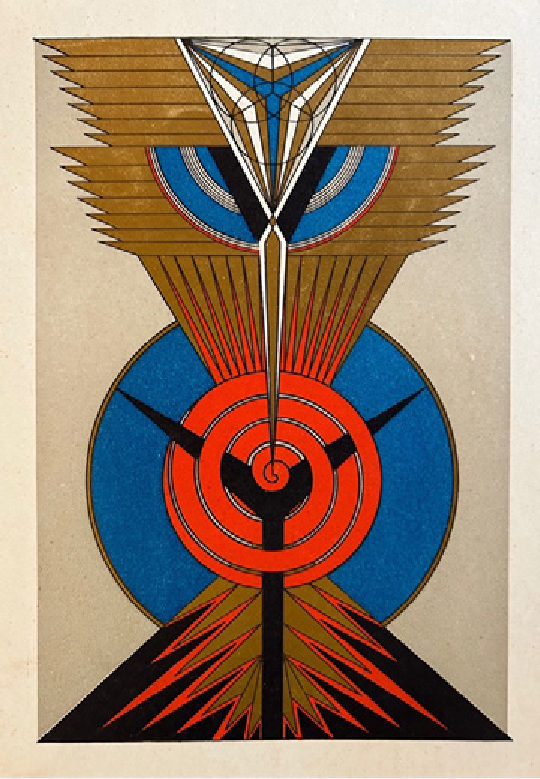
Olga Fröbe-Kapteyn, Die Verkündi-gung (The Annunciation), 1932. “Meditation Plate” series, c. 1926-34. Tempera, India ink and gold leaf on cardboard. Item no. 0.35BIBO. Folder 35002. C. G. Jung-Institut Bildarchiv, Küsnacht, Switzerland. Image: Chloë Sugden, reproduced courtesy of the C. G. Jung-Institut Bildarchiv, all rights reserved.
• All I can say is that if the spirit world looks like a ’40s Detroit hood ornament on acid, we’re in even deeper trouble than I thought.
“God of War Laufey is coming to the PS5” [The Verge]. “Sony ended its big State of Play showcase with a major reveal: the next God of War. The new title is called God of War Laufey, and is once again developed by Sony’s Santa Monica Studio. Currently, the game doesn’t have a date, but it’s coming to the PS5 whenever it does launch. This time, instead of perpetually furious dad Kratos, players will take control of Faye / Laufey, as the title implies. That means that while the tone of the game seems somewhat similar to past God of War titles, the gameplay looks quite different, with much more aerobatic action punctuated by magic instead of Kratos’ heavy violence. Also, there’s a giant, six-legged cat that can fly. And a talking gelatinous cube named Phranque that fights alongside you.” • “A talking gelatinous cube.” I wonder which political party Phranque belongs to?
“Parametricism is a technophile triumph of fetishised process over outcome” [Dezeen]. “From the get-go, parametricism came cloaked in clunking verbiage, the tell-tale flashy new clothes of an aspiring emperor. I used to teach a ‘how to avoid opaque writing’ seminar with students in which we dissected an impenetrable piece of Schumacher prose and attempted to fathom the meaning of phrases such as ‘the geometric transcoding of parameter variations into differentiated geometries.’ An entirely new style deserves an entirely new appellation – an entirely new language, in fact. Schumacher, the imperator of polysyllables, wrote the book on parametricism: the two volume Autopoiesis of Architecture, an impenetrable thicket of a manifesto, which it’s doubtful any of his Rhino-wrangling1 acolytes have actually read. Yet all this insistent intellectual posturing generates critical heft and momentum. Assailed by a parametric barrage of books, papers, theoretical tracts, seminars and social media posts, punctuated by the occasional statement building, you feel like Dorothy confronted by the Wizard of Oz in full imperious flow.” • An entertainingly brutal takedown. Parametricism was a word of the day on May 13.
1 Rhino is a 3D-modeling tool.
“Commas, Common Sense and Justice” [New York Times (via)]. “This is part of a long story Florence Hazrat tells in ‘On the Mark: From Periods to Interrobangs, How Punctuation Remade the World,’ due out in August. Hazrat takes us from when writing had no punctuation at all, through when it was invented largely as a guide to reading out loud, to today’s proliferation of marks like hashtags and emojis. Ancient Greek had no spaces between words, Hazrat writes, and Aristophanes of Byzantium, a librarian in Alexandria, found it cumbersome. He came up with a three-dot system to indicate how long one was to pause in reciting the text: a dot at bottom, middle and top. Top was a full stop, what we know as a period. Bottom was a brief pause, as in “comma.” Middle was if you wanted something in between, a kind of “I’m OK but just wait a sec” — kind of a semicolon. I’d like it if we could go back to that.” • Punctuation is a civilizational achievement, the first form of markup.†
†Text that is added to a document to describe its layout, logical structure, or other attributes to distinguish it from the actual content. “Is this a dagger which I see before me,“….
Bullwinkle: You just leave that to my pal. He’s the brains of the outfit.
General: What does that make YOU?
Bullwinkle: What else? An executive.
/ˈkatəlɒɡ / (US English catalog) ▸ noun a complete list of items, typically one in alphabetical or other systematic order. ▪ a list of all the books or resources in a library: a computerized library catalogue. ▪ a publication containing details of items for sale, especially one produced by a mail-order company: a mail-order catalogue. ▪ a list of works of art in an exhibition or collection, with detailed comments and explanations: this collection of paintings is the subject of a detailed catalogue. ▪ US English a list of courses offered by a university or college. ▪ [in singular] a series of unwelcome or unpleasant things: his life was a catalogue of dismal failures. ▸ verb ( catalogues)(, cataloguing)(, catalogued)(; US English catalogs)(, US English cataloging)(, US English cataloged) [with object] make a systematic list of (items of the same type): it will be some time before the collection is fully catalogued. ▪ enter (an item) in a catalogue: the picture was withdrawn before being catalogued. ▪ list (similar situations, qualities, or events) in succession: the report catalogues dangerous work practices in the company. – ORIGIN late Middle English: via Old French from late Latin catalogus, from Greek katalogos, from katalegein ‘pick out or enrol’.
“Maintaining Everything That Matters” [Protocolized]. “Stewart Brand is the founder of the Whole Earth Catalog, a “proto-Google,” [what] large-format printed compendium of tools, texts, and ideas that appeared between 1968 and 1972 and served as a declaration that anyone could have access to the tools to build something better. Shaped by Buckminster Fuller’s systems thinking, Gregory Bateson’s cybernetics, and Marshall McLuhan’s media theory, Brand’s message to the communes and hackers and back-to-the-landers was: think at scale and take responsibility for outcomes. The revolution, if there was to be one, would be built out of care and competency.” • A wonderful book. Politically, I’m not sure it worked out.
“John Travolta’s directorial debut is a rare piece of spellbinding autofiction” [Salon]. “To see Travolta’s latest films on your screen, you’d have to scroll into the dead zone of a streamer’s catalogue. There, you’d find a handful of selections where one of the last century’s most bankable faces resorts to playing a gun-toting sheriff or a gun-toting thief, often directed by the ex-boyfriend of a “Vanderpump Rules” star. Travolta’s recent output is a far cry from the days of “Pulp Fiction,” “Blow Out,” “Face/Off,” or any of the other two-word titles that proved the actor was more than just a high school greaser or disco dancer. (Though if his last great film role ended up being his Divine-channeling Edna Turnblad in 2007’s “Hairspray,” there would be no complaints from me.)” • It’s wondeful thing to live in a world where John Travolta can brilliantly portray Bill Clinton in Primary Colors. But I really added this find just so I had an excuse play this clip, showing what a marvellous dancer Travolta was:
Of course, Uma Thurman is pretty good. And Chuck Berry’s no slouch (wonderful lyrics, with the “old folks” acting as a Greek chorus). Sadly, I can’t get Google to discorge the version that fades out properly.