
Don’t Miss These
(1) Festival of Platner: “Graham Platner supporters celebrate after their candidate’s primary victory” • Quotes from the locals, who are far more humane than DC.
(2) “FCC Wants to Kill Burner Phones By Forcing Telecoms to Get All Customers’ IDs” • Orwell would be proud.
(3) “AI’s Elusive Returns” • Even more elusive with usage-based pricing!
(4) “The first legal structure for artists in America is now law” • Good news!
Birdsong of the Day
Moar mimidae:
Arrogo Norvilla Oaxaca, Mexico (1954). I’m really liking this ’50s American voices, besides the birds.
“Around North America, Community Members Are Stitching Nearly 11,000 Birds” [This is Colossal]. “It’s estimated that around one billion birds die in window collisions annually throughout North America. One of the organizations working to collect this data and—just as importantly—to protect, rescue, and advocate for avians is the Chicago Bird Collision Monitors (CBCM) program. Every morning, volunteers walk the streets of the city to count and collect fallen individuals, taking them to wildlife sanctuaries for treatment or rehabilitation where possible. Most, however, don’t survive the impact.” Skipping the art part for the moment: “Businesses like Feather Friendly make products that can be applied directly to any window, most commonly in the form of small vinyl dots. It also offers Bird Divert, which uses clear dots that are actually hard for us to see, but due to the way birds’ vision works, the application helps them to differentiate between architecture and nature. Fritted glass is another method, which involves ceramic details baked right onto the surface of the glass.” Now the art:
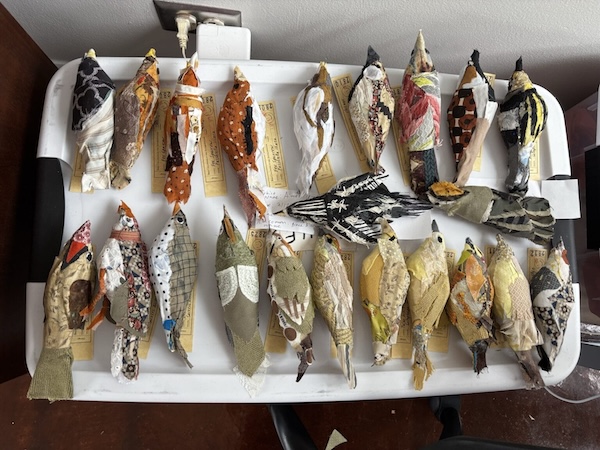
More: “While the official number of finished birds is currently at 3,451, [when artist and educator Holly Greenberg heard’ estimates there are at least 1,000 more [collided birds] awaiting tagging and entry into the [Bird Collisions in the Anthropocene] handwritten ledger, which is reminiscent of museum catalogues before computerized records came into widespread use. With the help of a team of interns, she labels each bird individually with its species name, its artist, and where it ‘flew’ in from. And installation opportunities abound. Eventually, the birds will create one giant “carpet” to illustrate not only the poignant and urgent reality of bird collision deaths, but the power of collective action. In the meantime, groups of the fabric critters go on view occasionally in other exhibitions.” • I’ve read this twice, and the citizen science aspect vs. the artistic aspect still confuses me. Perhaps a reader can clarify. Either way, or both ways, it sounds like a neat project.
Politics
Festival of Platner
“Platner sails through primary amid controversy: 5 takeaways from Tuesday’s elections” [The Hill]. “As of 12 a.m. Wednesday, with nearly 70 percent of the vote reported, Platner secured about 72 percent of the vote while Mills garnered nearly 20 percent, according to DDHQ. Democrat David Costello had just 8 percent support. Another key test included whether the vote in Maine’s Democratic gubernatorial primary drastically exceeded the vote in the Senate race. There is a minimal imbalance between the two contests, with about 129,400 votes cast in the upper chamber’s race and nearly 129,600 votes reported in the governor’s primary.” • IIRC, 72% of the vote matches the polling before the scandals emerged.
The locals:
“Graham Platner supporters celebrate after their candidate’s primary victory” [Bangor Daily News]. “Graham Platner’s supporters clapped, cheered and stomped their feet at the Blue Hill YMCA on Tuesday night as organizers announced he had won the Democratic nomination for Senate.” The widish-angle photo shows a nice mixed crowd, skewing young. More: “Speakers throughout the night, including Platner himself, characterized the campaign as a movement that’s bigger than him and vowed to beat U.S. Sen. Susan Collins in November.” Quite a collection of quotes from supporters: “Numerous attendees said they felt stories about Platner’s past were establishment attempts to smear him that won’t work on voters here. Some empathized with his past struggles and said they’re more focused on his message. ‘They’re campaigning so hard against him, because he is a normal person,’ said Romane Taylor, 62, a retired corrections worker, while leaving the polls in Caribou earlier in the day…. ‘He’s young and he’s got balls,’ [David Hardison, a 70-year-old farmer from Dedham who arrived to the YMCA in a truck decorated with anti-Trump and anti-Collins sentiments.] said of his support for Platner. He wishes the recent revelations weren’t there, Hardison said, but feels everyone has skeletons in their proverbial closets and Republican candidates have darker histories…. ‘We’ve all got a past,’ [Frank Donnelly of Lamoine] said of recent Platner headlines…. Genevieve Lemire came to Blue Hill from Pembroke, where she’s now running for the Maine House herself after being inspired by Platner.
She saw her own family members struggle after returning from Vietnam, something she recognizes in Platner. ‘People go through things,’ she said. Kimo Bailey, who votes in California but has long family roots in Maine and grew up in Freeport, expects recent headlines will fade. ‘Mainers are not easily bought off,’ he said. ‘All people have to do is listen to what [Platner] says.’” • Hmm. More quotes—
“He knows what the real problems are and how to talk about them.”“Graham Platner secures Democratic nomination in U.S. Senate race” [Maine Morning Star]. “When asked whether Platner’s controversial personal history led him to reconsider his vote, Newport resident Jim Miller said at the polls Tuesday, ‘It made me like him more.’ ‘You usually get a bunch of platitudes from these politicians,’ Miller said. ‘Well he doesn’t say stuff like that. He knows what the real problems are and how to talk about them.’… ‘Anybody that’s going to run against Susan Collins is going to be torn apart no matter who they are, said [John Crimmins of Bangor]…. Jane Burkhart cast her vote for Platner on Tuesday: ‘Even amidst all the smear that’s going on — we’ve all done bad crap — I think he’s the change that we need. And we definitely need a change.’” • Sensing a theme…
“Graham Platner’s wife Amy Gertner and parents: What we know about Maine senate candidate’s family” [Hindustan Times]. “Platner married Amy Gertner in fall 2023. The couple live in Sullivan in Maine, where they run the Waukeag Neck Oyster Company, which Platner took over in 2019 after his military career, per Newsweek. Gertner previously worked as an elementary and middle school art teacher. The two met through friends before matching on the dating app Bumble, according to an interview with The New Yorker. Gertner has also been working on her husband’s campaign since it launched in August last year, with Federal Election Commission records showing 16 payroll disbursements totalling $29,042.14, per Newsweek. In an interview with The New York Times in May, Platner said he and his wife together earn around $60,000 a year and get by partly through his veterans’ benefits.” More: “His father, Bronson Platner, 81, worked as a local attorney specializing in real estate and business transactions. His mother, Leslie Harlow, 72, ran several local businesses and now owns and operates Ironbound restaurant in Hancock. She had also been a delegate at the 2004 Democratic National Convention and a former county party chairwoman and has hosted political fundraisers at her rustic inn and event space, according the New York Times cited by Newsweek.” So the mother is wired into the Democrat Party, too. More: “His grandfather, Warren Platner, was a renowned architect. Despite Platner’s working-class image on the campaign trail, critics have pointed to his privileged background. His father has donated more than $65,000 since 2011 to federal Democratic candidates, including $3,500 to Senator Ruben Gallego weeks after Gallego endorsed his son, according to New York Times. Bronson Platner also paid for his son and daughter-in-law to travel to Norway for fertility treatments, a source told the Times. Platner briefly attended the elite Hotchkiss School in 1999, where annual tuition was around $25,000, fees now start at $68,700. He received financial assistance but was eventually expelled, telling the Times he felt out of place among wealthy students, per Newsweek.” • All chump change by billionaire standards.
The Beltway:
“AOC calls Platner allegations ‘Hard to stomach,’ emphasizes Maine election is ‘a choice’ ” [The Hill]. “ ‘Obviously, there’s a lot in that behavior that’s really challenging — it’s hard to stomach,’ she told CNN’s Manu Raju outside of the Capitol on Tuesday.” Thanks, Alex, good job. More: “Ocasio-Cortez said in separate comments to reporters on Tuesday that Democrats are not brushing aside the allegations against Platner. But, she emphasized that the race is ‘up to the people of Maine and the choices that they have before them.’” • See the quotes in the first story under “the locals.” Sounds to me like Alex thinks the people of Maine are deplorable.
“Khanna: Maine voters gave Platner a ‘chance at redemption’ with primary win” [The Hill]. “ ‘He talked about Maine giving him grace, Maine giving him a second chance, he talked about the need to earn people’s votes, so this was not an arrogant speech,’ Khanna said on CNN after Platner’s victory speech. ‘He understands that he needs to do work, and he understands that they’re giving him a chance at redemption.’ The Democratic lawmaker said that Platner’s speech displayed ‘both humility and strength’ amid a series of controversies over his past social media posts and alleged behavior toward women. Platner will now face incumbent GOP Sen. Susan Collins in the November election. Collins ran uncontested in the state’s Republican primary. ‘Susan Collins is formidable, but Graham has had a terrific night,’ Khanna said on CNN.” • Good framing (although I would argue the redemption — let me shift into the subjunctive, so I’m not too much of a fan boi — would have been earlier, and in private).
“The Democratic establishment begrudgingly moves to embrace Graham Platner” [Politico]. “Senate Majority PAC, the super PAC aligned with Democratic leadership, similarly sought to draw contrast between Platner and Collins. ‘The difference between the two couldn’t be plainer: Platner’s agenda supports working people and families, while Collins upholds Washington’s status quo,’ spokesperson Lauren French said in a statement.” It’s like Democrats have had the ability to pronounce the words “working class” surgically removed. Meanwhile, the views of a CIA Democrat: “Still, others like Sen. Elissa Slotkin, a potential 2028 presidential candidate, deflected on answering questions about the allegations and expressed deep frustration: ‘I look forward to the day where I am not answering every single week a question about bad behavior by another dude,’ she told MS NOW this past weekend.” • “Dude,” ffs.
“Platner holdout floats emergency lifeline for panicking Dems if scandal-plagued candidate wins” [FOX]. “[Democrat Rep. Josh] Gottheimer, who represents Bergen County’s deep-blue New York City suburbs and the rural ruby-red Skylands of the state’s northwest, said that if Platner tried to run in the Garden State, ‘we’d throw him off the ballot or bury him under the Meadowlands.’” • WTF is “bury him under the Meadowlands” supposed to mean? Does Gottheimer plan to get one of his Mossad buddies to whack him?
* * * “Platner’s big night: 5 takeaways from Tuesday’s primaries” [Axios]. “Platner’s victory was also the latest one for Democratic progressives in their ongoing civil war with the party’s moderates. Standing behind a sign that defiantly read, ‘They Don’t Know Maine,’ Platner delivered an acceptance speech that mixed talk of his past regrets and slammed elites who’d opposed him. ‘The national pundits, the political establishment, they keep looking for that one story, that one headline, that one moment in my life that they can define the campaign by,’ Platner said. ‘But in trying so hard to understand me, they failed to understand that this is not about me at all. This is a movement about us.’ Late Tuesday, Schumer and Senate Democrats’ top super PAC put out statements making clear they support Platner.” • I trust Schumer as far as I can throw a piano. A concert grand.
“The Likely Platner-Collins Matchup Is Set to Be Hugely Expensive” [New York Times]. “Mr. Platner, whose campaign has been roiled by various scandals, has out-raised Ms. Collins. His main campaign committee raised $16.2 million between January 2025 and late May of this year, according to federal election filings. The Collins campaign brought in $11.8 million over the same period. But Ms. Collins, who has been in office for nearly 30 years, has more help from outside groups supporting her with advertising. She has been the beneficiary of more than $19 million so far from the conservative dark-money group One Nation and nearly $7 million more from another dark-money group, according to data as of Monday afternoon from the media tracking firm AdImpact. Mr. Platner has also received support from dark-money groups buying advertising, with nearly $6 million in anti-Collins ads from Majority Forward, the nonprofit arm of Senate Majority PAC, the main super PAC backing Democratic Senate candidates. Two other groups, Unrig Our Economy and Duty and Honor, have also each spent more than $2 million on ads attacking Collins.” • Of course, as I show here, the Democrat Party is in essence a money circuit flowing from oligarchs through media buyers back to the oligarchs who own the media. So everyone taking a cut along that circuit is a winner. Whether any given candidate wins or not, well, that’s a happy by-product.
Trump Administration
“FCC Wants to Kill Burner Phones By Forcing Telecoms to Get All Customers’ IDs” [404 Media]. “The Federal Communications Commission (FCC) wants to make it effectively impossible for people to buy what many call burner phones—a phone not explicitly linked to your identity at the point of purchase—which would impact privacy-conscious people, to domestic abuse survivors, to journalists, and many more. The FCC plans to do this by legally forcing the country’s telecoms to store a wealth of personal information about essentially all phone customers, including a government issued identification number and their physical address, alarming privacy advocates and civil rights activists who compare the measures to those from authoritarian countries where it can be difficult to buy a mobile phone plan without giving up your identity.” • YIkes. We need a Constitutional Amendment for burner phones just like we need a Constitutional Amendment for cash.
“Homeland Security retreats on plan to get data on mail-in voters” [News from the States]. “The U.S. Department of Homeland Security is walking back, for now, a plan to sweep up data on millions of Americans who vote by mail under President Donald Trump’s executive order restricting mail ballots. In a federal court filing Monday night, the Justice Department significantly hedged the data-sharing plan, pulling back from a position the Trump administration advanced last week. DOJ lawyers now cast the idea as in the early stages and dependent on approval of a new U.S. Postal Service rule for mail ballots, citing a memo that Homeland Security Secretary Markwayne Mullin signed earlier Monday.” • For now.
“Who is the Villain in Mars Sample Return?” [Mars For The Rest of Us]. “It’s entirely NASA’s fault. Congress gave the space agency billions of dollars and years to bring a sample home from Mars, and NASA flubbed it. All they had to do was fly a single Martian pebble back to the vicinity of Earth, where scientists with cyclotrons and fancy microscopes could have swarmed all over it. If those investigations had found the smallest trace of life, rivers of money would have then flowed into Sample Return II. The NASA of the 1970s could have pulled this off! But instead, the project disappeared into the bureaucratic haze that seems to have eaten the agency from within. For all the supporting villains I listed, it’s our own space program that no longer seems up to the task of actually exploring space. For the first time, a technical challenge proved insurmountable given ample time, budget, and manpower. And the effort failed largely for organizational reasons. That seems like an ominous sign for the future.” • Fun stuff. Cegłowski’s old blog, Idle Words, had for its motto “brevity is for the weak.” So should his new Substack!
“White House cedes press credentialing authority to UFC for Freedom 250 event” [Awful Announcing]. “[T]he White House has ceded control of press credentialing to the UFC, and only reporters approved by the Dana White-run fighting promotion will be able to cover the event on premises.” • I can see ceding executive authority to Israel under Section 224; at least Israel is another sovereign. But to The Ultimate Fighting Championship?
Geopolitics
“Undercover Reporters Confirm Russian Paramilitary Presence on Tankers” [The Maritime Executive]. “The Danish pilots who guide merchant ships through the Oresund have often reported the presence of strange uniformed men aboard Russia-linked tankers that pass through the waterway. Not apparently burdened with seafaring duties, these supernumeraries nonetheless seem to have a degree of authority on board - raising suspicions of paramilitary or intelligence ties to the Russian government.” • Maybe they’re concerned about piracy.
“America Just Added a Massive New Rare Earth Supply Source” [OilPrice.com]. “REalloys (NASDAQ: ALOY) has signed an agreement that could give it priority access to up to 30% of production from a 2-billion-ton Appalachian rare earth resource network, expanding its growing pipeline of domestic and allied feedstock ahead of the Pentagon’s 2027 ban on Chinese-origin materials. The deal comes just two months after unveiling its buildout of the largest heavy rare earth metallization facility outside of China. Under a new Letter of Intent released on Wednesday with Patriot Exploration & Mining, REalloys would gain preferential allocation rights to rare earth production from more than 150 tested sites stretching across the Appalachian Basin from Alabama to Pennsylvania. It’s an all-American resource base that contains neodymium, praseodymium, dysprosium, and terbium–the four magnet metals at the center of the Pentagon’s effort to remove Chinese material from U.S. defense supply chains.” • An “all-American resource base,” eh? I wonder how the locals feel about supplying ‘feedstock.”
Pandemics and Public Health
Stay safe out there!
Maskstravaganza
“Indie bookstores promoting masking and COVID-19 consciousness in 2026” [The Sick Times]. “[A] number of independent bookstores… still require or strongly encourage masking in an effort to keep staff and the general public safe. Recently, we searched out as many of these stores as we could and contacted booksellers…. directly to get a sense of their reasons for continuing mitigations and their experiences doing so. We limited our search to stores within the United States, and were also limited by the amount of information we were able to find within a reasonable time frame, so we believe that the number of bookstores (and other community spaces) with masking policies and sometimes additional mitigation measures extends far beyond those that will be mentioned in this article. In communicating with booksellers, we also discovered evidence of a much higher level of COVID-consciousness and desire for health protections among the public than the overall tenor of mainstream media and prominent conversations suggests.” • Well worth a read, but the article is more a series of interviews with six stores than a survey.
Elite Maleficence
This system builds in an incentive for nursing homes to cut costs by taking high-need residents while understaffing“Methodology: The Numbers Behind the Ensign Investigation” [Hunterbrook]. CMS reimburses skilled nursing facilities (SNFs) on the basis of resident care needs rather than solely on the services they provide. Those care needs are also referred to as an acuity level. The vast majority of Ensign’s certified nursing facilities are SNFs…. This system builds in an incentive for nursing homes to cut costs by taking high-need residents while understaffing. In its 2025 10-K, Ensign even said it’s focusing on very sick people to increase reimbursement from the government. As part of our investigation, Hunterbrook Media estimated the profit a nursing home could pursue by understaffing for the level of its residents’ conditions.” And: “The gains from understaffing added up to $6.5 billion for all 13,670 certified nursing facilities nationwide as reported in CMS provider information data for our study period – that works out to a median value of $379,622 per facility.” • Ka-ching.
“1 in 5 U.S. adults denied doctor-recommended care: Commonwealth Fund” [Healthcare Dive]. “1 in 5 adults with private insurance report that they or a family member were denied coverage for medical care recommended by a doctor in the past year, according to new research. The study, released Thursday by the Commonwealth Fund, found insurance denials before care was provided delayed patients’ treatments and worsened their health problems. Denials after care frequently left patients with unexpected medical bills or threw them into long-term debt.” • “Ask your doctor.” BWA-HA-HA-HA-HA!!!!
Business Sentiment
“The rebound is visible in the Logistics Managers’ Index, which showed transportation prices increased in May at the fastest rate for any metric in the report’s 10-year history” [WSJ Logistics Report]. “And dry-van spot rates were up 52% year-over-year last week, excluding fuel charges, according to FTR Transportation Intelligence and Truckstop.com. Trucking specialists now say the industry has finally found equilibrium after four years in which carriers were squeezed by too many trucks on the road and not enough loads. Although consumer demand and home construction have been relatively flat, factory activity and data-center development are accelerating freight volumes.”
Today’s Fear & Greed Index: 34 Fear (previous close: 33 Fear) [CNN]. One week ago: 53 (Greed). (0 is Extreme Fear; 100 is Extreme Greed). • Another big swing to fear!
Business: AI
“AI’s Elusive Returns” [Global Finance]. “A study of more than 300 publicly disclosed Gen AI initiatives, published last July by the Massachusetts Institute of Technology, found that despite $30 billion to $40 billion in enterprise investment, 95% of the projects generated no return. A survey of 1,854 executives, published in October by the consultancy Deloitte, found that while 85% of the organizations had increased their AI investment in the previous 12 months and 91% were planning to do so again by year’s end, just 10% were realizing ‘significant’ returns on their spend on agentic AI.” And that’s last year, when tokens “worth” $100 were selling for $5, as Ed Zitron said. But: “And those investments are likely to become more expensive as AI vendors shift from a subscription model, which offers unlimited use at a fixed price, to usage-based pricing…. In an interview with Global Finance, Nicolai von Bismarck, a partner and leader of McKinsey’s service operations practice, describes the shift as ‘structural and accelerating.’ He adds, ‘The cost uncertainty this creates is real: It’s showing up in research as one of the top operational barriers to scaling AI.’ Small wonder, then, that banks are growing wary of lending to operators of data centers that support AI. JPMorgan Chase, Morgan Stanley, and Sumitomo Mitsui Banking Corp. are among those seeking to offload their ballooning data-center loan exposure to private funds and insurers. For example, banks have been trying to syndicate a $38 billion debt package tied to Oracle for six months and are offering it at a discount.”
Too much even for banksters:
Very important point: SoftBank was pledging *all* of its OpenAI stock (worth $60bn+ on paper) to get a $6 billion margin loan. Banks turned it down due to concerns about the value of OpenAI stock. Banks clearly do not think OpenAI is worth $852 billion.https://t.co/B9ilbd043M https://t.co/ZOukSi63Ov pic.twitter.com/mYY4xkFTGO
— Ed Zitron (@edzitron) June 10, 2026
Business: Tech
“Cops Keep Getting Arrested for Using Flock to Stalk People” [404 Media]. “[Jarmarus] Brown told King that he believed his ex was lying about her whereabouts. She ‘told Jarmarus she was at her house with her mother, but Jarmarus knew for a fact she was not. When questioned by Officer King as to how he knew for a fact she was lying, Jarmarus said he used the Flock system and saw that her vehicle was elsewhere,’ the affidavit reads. ‘Jarmarus then asked Officer King if he wanted to join him on a ‘stakeout’ to try to see where her vehicle was located. According to Brown’s ex-girlfriend, while they were dating he would ‘constantly require [her] to either be on FaceTime with him or be on the phone with him, even while she was working […] Jarmarus would try to control aspects of [her] life, such as the amount of makeup she would wear and the length of her fingernails.’ According to the affidavit, Brown’s stalking extended beyond license place lookups; at one point while they were dating, he put an Apple AirTag in her wallet. But the bulk of his surveillance came through Flock, the affidavit says, noting that he kept ‘randomly showing up at the places she was at.’” • I’m sure tech bros do the same thing, so what’s the issue?
“macOS 27 Golden Gate includes these changes that Tahoe critics will appreciate” [9to5 Mac]. Key point: “macOS 27’s Liquid Glass slider is the most significant in terms of giving users control over the system appearance. Liquid Glass isn’t just a choice between Tinted and Clear now. The slider lets you dial in the precise amount of translucent warping or tinted consistency in Liquid Glass elements.” • If I can turn that crap off entirely, I’ll consider upgrading.
Business: Manufacturing
“Beyond the hype: The hidden labor drain of manufacturing’s data paradox” [Manufacturing Dive]. “According to a new study of over 600 industrial leaders published in the Manufacturing Data Paradox Report, a staggering 50% of manufacturers still rely on manual data collection methods for their frontline teams. This creates a highly fragmented, hybrid operational environment. We are drowning in automated machine data, yet we remain entirely dependent on manual human entry to understand context. The result isn’t a digital evolution—it is a data paradox that is actively draining your most valuable human resources. When machine data and human workflows don’t sit in the same ecosystem, the burden of bridging that gap falls squarely on plant floor leadership. The report highlights a sobering reality: nearly two-thirds of frontline supervisors spend at least one hour per shift just cleaning and reconciling data. Think about what that means for a multi-shift, multi-line facility. Thousands of hours of highly skilled leadership are redirected away from coaching teams, optimizing lines and eliminating bottlenecks. Instead, supervisors are acting as manual data couriers—stitching together fragmented reports just to prove what happened yesterday.” • I’m ambivalent. I don’t thiink you can understand data without touching it (i.e., dashboards suck). But not all the touches add value.
Business: Retail
“The revenue leak every retail executive is ignoring” [Payments Dive]. “Every transaction that reaches checkout gets a decision: approve or decline. That decision is made billions of times a day by systems built to stop fraud, not protect revenue. The gap between them has a price tag. Research consistently estimates that roughly $50 billion in legitimate U.S. orders are declined annually. Not fraud stopped, but real customers with valid payment methods who couldn’t complete their purchase. Industry estimates put the false decline rate at 2% to 10% of all declines. For a mid-sized retailer processing five million transactions a year, even the low end means approximately 150,000 orders that never closed. At the current U.S. e-commerce average order value of $183, that’s around $30 million in vanished revenue with no alert, no report, and no flag. Then it compounds. About 40% of customers who experience a false decline don’t return. You paid to acquire them. You got them to checkout. Your fraud system handed them to a competitor. That outcome doesn’t appear in any fraud report. It surfaces, if it surfaces at all, as a quiet gap in repeat purchase rates attributed to pricing, product, seasonality—anything except the actual cause.” • Hmm.
The Gallery
I see that how the paint is laid down is successful. But I’m still not sure I like it:
Childe Hassam
Rainy Night, 1895 pic.twitter.com/aZnlPIauhv— Dan Berthod (@DanBerthod) June 4, 2026
Science is Popping
“Scientists sound the alarm as dangerous amoebas spread globally” [ScienceDaily (KF)]. “In a perspective published in the scientific journal Biocontaminant, researchers describe free living amoebae as an overlooked public health risk that needs far more attention. They point to climate change, aging water infrastructure, and weak monitoring systems as factors that could allow dangerous amoebae to spread and become harder to control.” And: “Amoebae are single celled organisms that commonly live in natural environments such as lakes, rivers, soil, and water systems. Most do not harm humans, but a small number can cause severe disease.” More: ” One of the best-known examples is Naegleria fowleri, sometimes called the brain eating amoeba. This organism can cause a rare but extremely deadly brain infection when contaminated water enters the nose, often during swimming or other recreational water activities. ‘What makes these organisms particularly dangerous is their ability to survive conditions that kill many other microbes,’ said corresponding author Longfei Shu of Sun Yat sen University. ‘They can tolerate high temperatures, strong disinfectants like chlorine, and even live inside water distribution systems that people assume are safe.’” • But do they have opposable thumbs?
Groves of Academe
“University of California Professors Are Begging Schools to Reinstate the SAT” [Wall Steet Journal]. “More than 1,100 California math and science professors are urging UC regents to reinstate college-entrance exams, saying that unprepared students are lowering academic standards and draining teaching resources. The request, delivered in a two-page letter last week, cites a sharp decline in readiness among students studying science, technology, engineering and math. Nearly one-third of students taking first-semester calculus at UC Berkeley ‘displayed severe preparation deficits,’ the letter said.
“Uc Freshmen Increasingly Are Not Ready For College Math. Some Professors Want To Require The Sat Again” [SFGate]. “The students came for calculus help but struggled to answer a middle-school level algebra problem: solving for x from the equation 7x - 5 = 9. ‘I told everyone to drop their pens and watch,’ Stankova said. ‘We had to go through it step by step.’ Across the University of California, math faculty say they are increasingly teaching first-year students who are unprepared for college-level math and unable to survive coursework for UC’s rigorous science and math majors.” And: “Faculty argue that other key admissions criteria don’t provide enough information about students’ preparedness. Grade inflation makes it more difficult to put stock in a student’s grade point average, and the proliferation of artificial intelligence means they can’t trust that applicants are writing their own essays. ‘So with that, there is no objective measure for math readiness,’ Stankova said.” But: “Test opponents point to a fall 2025 report authored by Saul Geiser, a senior researcher at UC Berkeley’s Center for Studies in Higher Education. The report found that grades were a stronger predictor than test scores of first-year success at Ivy League and other elite colleges, and that ranking applicants by SAT scores disadvantages Black, Latino, low-income and first-generation students.” • Sigh.
Class Warfare
“Do We Need Billionaires?” [I am BARRY HESS]. “I’m an entrepreneur myself. I’ve been risk-taking to some degree most of my career. Yet I don’t understand how anyone can honestly say that we badly need risk takers of the hundred-billionaire type to keep our economy going. I think it’s a fundamental misunderstanding, or a disingenuous re-staging, of the numbers I presented at the beginning of this post. A billionaire is so incredibly rich that it defies comprehension, and thus makes our discussions around all of this unhinged. Ah, but you say we need the industry that those hundred-billionaires create. But…do we? Is AI software worth it? Self-driving cars? Or is that the wrong question? Would making a mere ten billion dollars put off a mega-entrepreneur from seeking their place in the history books? Do we really need to give a select few individuals this society-warping level of power in order to get these advancements? I really can’t imagine that’s the case.” • Interesting discussion in plain language.
“Solving the ‘economic problem’ ” [The Next Recession]. “Last weekend, the World Inequality Lab (WIL) organised the third edition of its World Inequality Conference, held at the Paris School of Economics. The WIL hosts and maintains the World Inequality Database, the open-access database on global inequality. Probably the most famous of the WIL team are directors, Thomas Pikkety and Gabriel Zucman, the former for his magnum opus Capital in the 21st century and subsequent books.” And: “In the report, the authors claim to “set out a new vision for global progress in the 21st century: grounding human development and equality in planetary habitability.” As such, in my view, it is both ambitious and moderate at the same time. It is ambitious in showing how global prosperity and solving the climate crisis might be achieved; but it is also moderate – as according to the authors, it cannot be achieved for 75 years! That’s a long time for several billions of humanity and the planetary species.” And: “My own criticism of the report is that it bases itself on distribution after the event, not on ‘predistribution’ ie having collective ownership and control of corporate power. The policy answers offered in the report are: redistributing income through progressive taxation and social transfers; more public investment in education and health; and a global currency system. What is missing here? There is no policy to change radically the socio-economic structure of the world economy – in effect, capitalism is to remain.” • Once again, the central question in American politics, but at the world level. Very interesting approach, though, if you grant its premises.
News of the Wired
“The first legal structure for artists in America is now law” [Yancey Strickler]. “Yesterday morning, Governor Polis signed the Colorado Artist Company Act — the law that creates Artist Corporations (A-Corps), the first legal structure in the United States built specifically for how artists work.” Interesting;
What the A-Corp does
An A-Corp is a new legal structure built on the familiar LLC framework, with artist-specific protections written into its foundation:
Artists keep control. At least 51% of voting shares stay with artists, always. The mission is protected. Every A-Corp states an artistic mission in its formation documents, and you decide whether that mission comes before financial goals, sits alongside them, or follows a balance you define. Your IP is yours. Your intellectual property counts as a capital contribution — its value is part of the company’s value — and reverts to the artists if the company dissolves. Ownership reflects reality. You can create shares and fractional ownership at formation, and separate economic rights from governance rights — so a band, a film crew, or a studio can build ownership that matches who made the work.
“AI blog question challenge” [Manuel Moreale]. “Am I against using AI? As a generative tool, yes. I refuse to ask AI to do something for me or to generate content from scratch. As a tech in general? I think it has some potentially useful applications in narrow contexts. As always, the answer is not cut-and-dry, and it can be yes or no depending on the framing and the scope.” And: “As for what I don’t like, how anthropomorphised these stupid tools are is definitely high on my list. I don’t want my computer to talk back or to make jokes or to say «I’m sorry». If I input a question, I want an answer back, and that’s it. I don’t want follow up questions, I don’t want some pointless preamble. I get why this happens, but I fucking hate it. This is software. I don’t want my software to have a personality. I want it to perform a task and get out of my way. I also don’t like the lying, the gaslighting, and all the other crap, and I also don’t like what the AI industry is doing as a whole, but that’s a separate issue.”
Plantidote of the Day
Via IIM:

IM writes: “Who needs the magic hour? Cottonwoods in Richmond, BC, on 120 mm film.” Film! Who needs the magic hour? I do. My goal is always to bang out at 5:00pm and go photographing.
Kind readers, I am running short! Send your plantidotes as attachments to lambert [UNDERSCORE] strether [AT] protonmail [DOT] com. And if you put “Plant” or “Plantidote” in the subject line, I’ll be less likely to lose it. Gardens are fine. Gardening season approaches, at least in the Northeast! Fungi and lichen are honorary plants.