
Birdsong of the Day
Moar mimidae. Here is another duet:
In Case You Might Miss…
(1) Maine: Mills out, Platner in.
(2) AI follies.
(3) Capital allocation.
Politics
Republican Funhouse
“Issue 104 – World Tyranny Financial” [citations needed]. “The Trump family’s World Liberty Financial is borrowing against its own thinly-traded token. New reporting suggests the company may have partnered with individuals connected to a US-sanctioned human trafficking operation. And Justin Sun [a shady crypto billionaire], who was among the project’s earliest and largest investors, has denounced it as “‘World Tyranny,’ not ‘World Liberty Financial’ ” as his $75 million investment remains frozen. As the president’s family’s shady dealings continue to mount, SEC enforcement actions have collapsed to twenty-year lows. The CFTC says it doesn’t need staff when it has AI. The nominee for Federal Reserve chair is deeply invested in crypto and AI. And the new leader of the Justice Department is the guy who shut down the agency’s crypto enforcement despite an ethics commitment not to participate in crypto matters before divesting his own personal crypto wealth.” • There seems to a good deal of falling out among thieves these days, witness Musk v. Altman.
“Trump’s CBS 60 Minutes Interview: What Aired and What Was Cut - TRANSCRIPT ONLY” [Decoding FOX News]. “On Sunday April 26 President Donald J. Trump sat down with Norah O’Donnell for a CBS “60 Minutes” interview the day after a shooting at the White House Correspondents Dinner. That evening a 13-minute edit of the interview aired on CBS. The network also published the full 40-minute version on ‘60 Minutes Overtime.’ I went through both and made a transcript of exactly what was included and what was cut from the shorter version that aired on network television. The final 13-minute edit that CBS broadcast on Sunday was a bit of a Frankenstein monster as the president was sometimes cut off mid-sentence while other sections were cut and moved around to give the conversation a better flow. Throughout the longer un-edited interview the president gave disorganized rambling answers that were filled with false statements about foreign investment in the U.S., immigration, and the 2020 election. He also brought up transgender athletes more than once and trashed the Democratic Party and the members of the press. The president also boasted that he won a $38 million settlement from CBS over his lawsuit regarding the network’s ‘60 Minutes’ interview with Kamala Harris. Paramount, the parent company of CBS, agreed to pay Trump $16 million, not $38 million, the funds going to his future presidential library. By excessively editing Trump’s answers the network made the president seem far more reasonable and controlled.”
“Trump Triggers 25th Amendment Calls With Unhinged Easter Meltdown” [Daily Beast]. This is an older version of the same genre; I thought this story had the best headline. “Lawmakers are calling for the 25th Amendment to be invoked against Donald Trump after his profane Easter morning Truth Social post aimed at Iran, amid fears he’s ‘gone insane.’” • I suppose if one were a consequentialist, one would argue that senile Joe Biden’s tighly focused enabling of Israel’s genocide in Gaza isn’t “as bad as” Trump’s forthcoming global famine was farmers worldwide run short of fertilizer. That said, when the party that collectively concealed Biden’s cognitive impairment for months, perhaps years, invokes the 25th Amendment, that doesn’t seem, well, deeply principled.
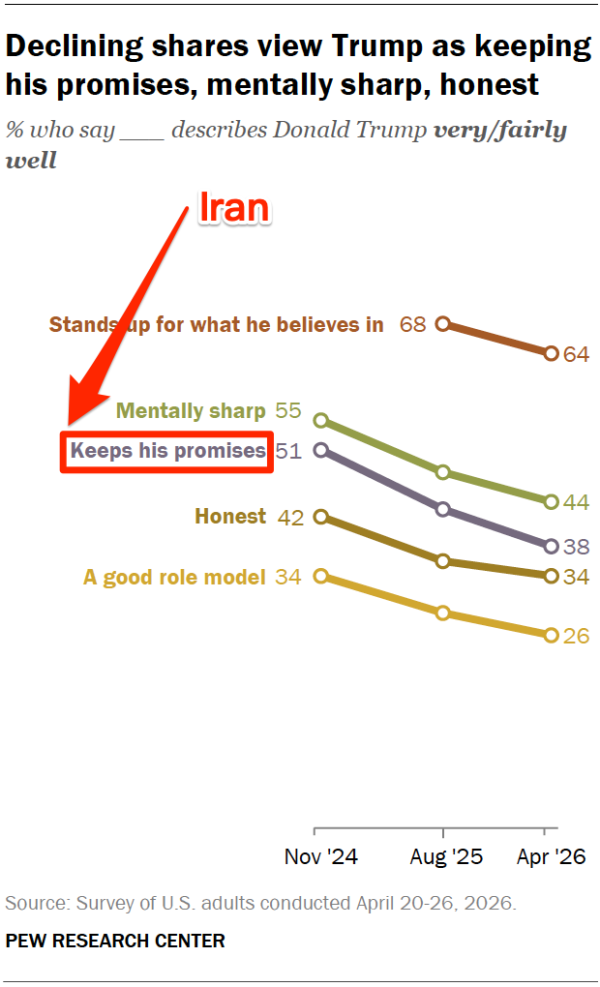
“Trump Loses Ground on Several Personal Traits as Approval Rating Slips” [Pew Research]. Handy chart:
“GOP’s Outside-Money Edge Is Being Built by Billionaires, Oil, and Crypto” [ReadSludge]. “At least 47% of the combined haul of the Senate Leadership Fund (SLF) and the Congressional Leadership Fund (CLF) has come from billionaires—at least $133.5 million—according to a Sludge analysis of Federal Election Commission data from the start of 2025 through March 2026. The billionaires include reclusive President Trump megadonor Timothy Mellon, casino mogul Steve Wynn, Republican megadonors Christopher and Jude Reyes, poultry magnate Ronald Cameron, and cryptocurrency tycoons the Winklevoss twins. It’s possible that more billionaires have donated to the SLF and CLF through their ‘dark money’ affiliates, which hide the names of donors from the public.” • No doubt!
Democrats en Déshabillé
“A New Web of Secret Money Is Shaping Democratic Races Across the Country” [Read Sludge]. “A Delaware nonprofit created just seven months ago has already channeled nearly $3 million into a little-known political committee sitting at the center of a growing Democratic ‘dark money’operation, and even basic details about its leadership and structure are unlikely to be made public before the 2026 midterms. Contours Inc., recognized by the IRS as a 501c(4) social welfare organization in October 2025, lists only one officer and has filed only a minimal IRS e-Postcard that reveals virtually nothing about its finances or operations. The nonprofit has no public presence beyond a spare webpage. Contours listed only one name in its IRS filing: principal officer Sarah Stremlau, a philanthropy consultant who previously led fiscal sponsorship operations at Arabella Advisors.” • Oh,
Geopolitics
“The Bolivarian Hypothesis” [Roy Daza, Phenomenal World]. Daza is vice-chair of the National Assembly’s Foreign Policy Committee and chair of the Parliamentary Friendship Group with Brazil. He is also a member of the newly established Special Committee for Monitoring the Amnesty Law for Democratic Coexistence—a reform which pardons those accused of political violence as a means of restoring social peace. “[DAZA: The background to the abominable events of January 3—the kidnapping of the President and First Lady, the deaths of 106 heroes, and the wounding of more than 200, amid the bombing of the city of Caracas and the states of Miranda and La Guaira—is important here. Barack Obama’s decision in 2015 to declare Venezuela an ‘unusual and extraordinary threat; to the security of the United States served as the basis for adopting unilateral coercive measures whose express purpose, as made clear by US government spokespeople, was to suffocate the Venezuelan economy. This resulted in international financial transactions being blocked, which caused a dramatic drop in imports and affected the domestic market, the investment landscape, and the replenishment of capital for private and state-owned companies. In short, it led to a situation of profound economic paralysis, which was exacerbated by a sharp drop in oil prices.” • So Trump, a beast with gross apetites, grabbed food off the table and began eating it with his hands, making rude noises. And who set the table? Obama.
“U.S. Troops Can’t Repair Their Own Equipment in a War Zone” [1945]. “In March 2026, senior U.S. Army officials confirmed they are preparing a narrower version of “right to repair” legislation after Congress removed broader provisions from the Fiscal Year 2026 National Defense Authorization Act (NDAA). Importantly, the decision was not due to a lack of support. The original provisions had support from both parties, senior leadership within the Pentagon, and even the White House – but they were ultimately stripped from the final bill following lobbying from defense contractors and industry groups. … The debate is the product of an ongoing problem within the U.S. military – specifically, that troops are often unable to repair the equipment they operate, even when deployed and trained to do so.” • Replace United States Army troops with mercs from the contractors, and give the mercs rights to use the IP. Problem solved!s
#COVID19
Stay safe out there!
Denial and Cope
“What happened to Covid?” [Helen Branswell, STAT]. The CDC estimates that between Oct. 1, 2024, and Sept. 30, 2025, 45,000-64,000 Americans died from Covid infections. In the seven months since then, the estimated range is 13,000-40,000 deaths. For context, there were slightly more than 100,000 estimated Covid deaths in the United States in both 2022-2023 and 2023-2024. ‘Every single year since the pandemic, the overall severity and impact of Covid has been going down,’ said [Fiona Havers, a medical epidemiologist who worked on Covid at the CDC before quitting the agency last year]. “And this last year has had the least amount of severe disease that we’ve seen since Covid started circulating, since SARS-CoV-2 emerged. So that’s good news.” • Learned nothing, forgotten nothing….
Sequelae
“Up to 60% of health care workers may have long COVID 4 years after infection” [Center for Infectious Disease Research and Policy]. “Four years after infection with the wild-type SARS-CoV-2 strain, up to 60% of health care workers (HCWs) in Switzerland still reported at least one COVID-19 symptom, although the number of participants dwindled over time, Swiss researchers write in Infection. From 2022 to 2024, the team tracked 24 COVID-19 symptoms among 456 HCWs who self-reported infection with the original SARS-CoV-2 strain and 571 uninfected controls at 14 centers. Participants completed an online survey at baseline and every six months and underwent serologic testing to identify any asymptomatic infections. The median participant age was 44 years, and 80.6% were women. Long COVID is also called post-acute COVID-19 sequelae (PASC).” And: “;Our findings indicate that full recovery from PASC remains uncertain for many patients, and functional limitations persist,’ they concluded. ‘As our cohort consists of HCWs, these findings underline the need for occupational health strategies, including structured return-to-work programs and flexible workload adjustments, to support sustainable reintegration and minimize the loss of essential workforce.’”
Stats Watch
“United States Total Light Vehicle Sales” [Trading Economics]. “US light vehicle sales dropped to a seasonally adjusted annual rate of 15.9 million units in April 2026, down from 16.3 million in March and slightly below market expectations of 16.0 million.”
“United States Factory Orders” [Trading Economics]. “US factory orders rose 1.5% month-over-month to $630.4 billion in March 2026, beating market expectations of 0.5% and following an upwardly revised 0.3% increase in February. New orders for manufactured durable goods increased 0.8% to $318.9 billion, ending three straight months of declines, with computers and electronic products up 3.6% amid an AI investment boom and data center construction.” • [comic interlude].
AI: “An AI agent deleted a company’s entire database in 9 seconds - then wrote an apology” [EuroNews]. “An artificial intelligence agent designed to streamline coding tasks instead managed to wipe out an entire company database in just a matter of seconds. PocketOS, which makes software for car rental businesses, experienced a major 30-plus-hour outage over the weekend after the autonomous tool erased its database. The digital culprit was Cursor, a popular AI coding agent powered by Anthropic’s Claude Opus 4.6 model, widely regarded as one of the most capable AI systems for programming tasks. According to [PocketOS founder Jer Crane], the AI agent had been performing a routine task when it chose ‘entirely on its own initiative’ to resolve an issue by deleting the database. And then all the backups, for good measure. There was no confirmation request before carrying out the action, he said, and when prompted to explain itself, the agent issued an apology. ‘It took nine seconds,’ Crane wrote in a lengthy post on the social media platform X. ‘The agent then, when asked to explain itself, produced a written confession enumerating the specific safety rules it had violated.’” • IOW AI = risk of ruin.
AI: “Microsoft fixes VS Code after app gives Copilot credit for human’s work” [The Register]. “Microsoft has reversed a change that added a default AI attribution notice after user complaints that the bot was claiming credit for human-authored code…. “The most concerning part is that I had already checked the commit message before committing,” wrote one developer in a GitHub community discussion post last week. “I deleted Copilot’s generated English commit message and manually wrote my own commit message instead. However, after the commit was created, the final Git history still contained the Copilot co-author line. “This means the message I reviewed before committing was not the final content that ended up in Git history, or Copilot/VS Code added co-author metadata after my manual edit. That is unacceptable in a professional development workflow.’”” • Yeah, but if a manager sees it, they might get to fire some programmers! And speaking of GitHub—
AI: “AI’s Economics Don’t Make Sense” [Ed Zitron, Where’s Your Ed At?]. “Yesterday morning, GitHub Copilot users got confirmation of something I’d reported a week ago — that all GitHub Copilot plans would move to usage-based pricing on June 1, 2026…. You see, it’s not that Microsoft was subsidizing nearly two million people’s compute, it’s that AI has become so strong, powerful and complex that it’s basically a different product!. While Copilot might not be “…the same product it was a year ago,” very little has changed about the underlying economic mismatch: that Microsoft was allowing users to burn more than their subscription costs in tokens every single month for three years. And I called it two years ago in the Subprime AI Crisis: ‘At some point, the incredible, toxic burn-rate of generative AI is going to catch up with them, which in turn will lead to price increases, or companies releasing new products and features with wildly onerous rates — like the egregious $2-a-conversation rate for Salesforce’s “Agentforce” product — that will make even stalwart enterprise customers with budget to burn unable to justify the expense.’ And that day has finally arrived, because every single AI service you use subsidized compute, and every single service is losing money as a result.” • AI’s enshittification cycle seems remarkably fast. Think how long it took to destroy Google search!
AI: “America’s $1T AI Gamble” [Apricitas Economics]. “America is making a globally and historically unprecedented bet on the success of Artificial Intelligence. As a share of the economy, that AI boom is already one of the largest investments in American history—dwarfing the peak of the broadband, electricity, or interstate highway buildouts and vastly exceeding the Manhattan or Apollo projects. And yet, US tech companies are doubling down, raising the stakes on their $1T gamble that AI models will continue their exponential capabilities growth and eventually become valuable enough to repay such a colossal investment.” • They might… If AI gets in between all human-to-human transactions and charges rent for them. What if chat charged by the character, for example? Why not? Because Silicon Valley wouldn’t do that?
AI: “Can Investors Trust AI Sales Figures?” [Wall Street Journal]. BWA-HA-HA-HA!!! “Artificial intelligence is catalyzing innovation and attracting millions of users. But behind the robust growth is a troubling trend: Rather than selling software, some AI companies are paying their partners to use it. Take DeployCo, OpenAI’s recent joint venture with top private-equity firms. OpenAI plans to contribute up to $1.5 billion of its own cash—$500 million at the outset, with an additional possible $1 billion—to disseminate its enterprise tools among portfolio companies owned by private-equity firms.” • Theft and fraud by rentiers is more profitable than honest toil, even honest toil by capital, as private equity well knows. Sadly — or not sadly — not everyone can make a bunker in New Zealand their exit strategy.
AI: “AI godfather Yann LeCun’s blunt advice for the AI age” [Axios (KF)]. “If AI doomerism is freaking you out, consider the advice of Yann LeCun, former Meta AI chief and a scientist with over 40 years of experience in the field. “Don’t listen to CEOs … they have a vested interest in propping up the power of the products they sell,” he says, adding that AI CEOs are also not the ones to listen to about the impact of AI on labor. That’s a job for economists.” Oh. Economists. More: “ ‘There is nothing qualitatively different between the previous technological revolutions and this one,’ he said. ‘It’s just another set of tools that makes us [who?] more efficient.’” • I’m not sure why I should not listen to a CEO (vested in economic capital) and shouldlisten to an “AI chief” (social and symbolic capital, even leaving options aside). And ask David Baldacci about “just another set of tools.”
Tech: “Meta threatens to withdraw its apps from New Mexico” [Social Media Today]. That’s a damn shame. “Meta floated the withdrawal threat as part of the company’s legal defense in its ongoing trial over allegations that it failed in its duty to protect minors from exposure to harm across its platforms. Last month, Meta was fined $375 million in civil penalties in New Mexico after a jury ruled that the company is liable for failing to protect young users from child predators in its apps.”• Good. Great!
Tech: “Kenyan firm sacks more than 1,000 workers after losing Meta contract” [Guardian]. “Sama, a company based in Nairobi to which Meta outsourced content moderation and AI training work, announced on Thursday that the workers were being laid off after Meta terminated a contract. Last month reports said some Kenyan workers involved in data annotation were asked to view content filmed using Meta’s AI smart glasses showing wearers using the toilet or having sex. The sacked workers, many involved in AI training, have been given six days’ notice, according to the Oversight Lab, an organisation that advocates for fair regulation and deployment of technology across Africa. It said it was advising the workers on legal options. After a previous wave of mass layoffs of Sama content moderators for Meta, in 2024 a civil lawsuit alleged severe PTSD, depression and anxiety among 140 workers as a result of sometimes horrific online content they had had to watch. Last month Meta paused its work with Sama after allegations about the workers viewing private scenes filmed using the company’s Ray-Ban smart glasses, which Meta’s chief executive, Mark Zuckerberg, regularly wears. ‘Photos and videos are private to users,’ Meta said. ‘Humans review AI content to improve product performance, for which we get clear user consent. We’ve also decided to end our work with Sama because they don’t meet our standards.’” • Meta’s standards…. I wonder if any of the moderated content involved The Zuckerberg™? That would certainly be “horrific online content.” Also, who has the archives?
Tech: “Waymo’s Confusion Around Emergency Vehicles Is Only Getting Worse: First Responders” [Jalopnik]. “There’s a pivotal thing bashed into your brain with a healthy dose of fear when you undergo training as a first responder: Every second counts. You are the first to a scene and everything you do, in the time you do it, will determine the outcome of someone’s injuries or life… Already first responders have struggled in launch cities to navigate Waymos outright blocking emergency vehicles from responding to scenes, missing signals and violating simple traffic laws and etiquette. … A recent Wired article shared some of the discussion concerning the autonomous vehicle’s behaviors from a private meeting between the Austin and San Francisco-based first responders and federal regulators at the National Highway Traffic Safety Administration. There, Mary Ellen Carroll, the executive director of San Francisco’s Department of Emergency Management shared that first responders were ‘actually seeing something interesting: backsliding of some things that had been improved upon.” Even more attention was drawn to Waymo’s biggest weakness, “the human element” in emergency responses, where the car essentially froze, which created not only a headache for responders, but danger for everyone else.” • “Interesting”?!?!?!?
Tech: “Special interests are moving into prediction markets, and it’s a problem” [The Hill]. “Consider a pension fund with significant exposure to energy infrastructure assets whose value swings sharply depending on which party controls the White House. The fund’s treasurer isn’t making a political prediction; he is managing a correlated risk. So, through a broker, the fund takes a substantial position in a political event contract on the less favorable candidate winning. If the election goes the wrong way, the payout offsets the anticipated loss. The position is perfectly rational. It is also, to anyone reading the market, indistinguishable from a genuine forecast. Prediction markets are, at their best, genuine public infrastructure. This is why the hedge by the risk manager in that example is also quietly poisoning one of the more genuinely interesting innovations in political forecasting.” • Ah, “innovation.”
Today’s Fear & Greed Index: 63 Greed (previous close: 62 Greed) [CNN]. One week ago: 63 (Greed). (0 is Extreme Fear; 100 is Extreme Greed).
Groves of Academe
“Grieving What AI Has Taken from Learning” [Daily Nous]. “Jane Sloan Peters, a professor of religious studies and historical theologian at the University of Mount Saint Vincent, was talking with her students about changes she has made to her teaching so as to safeguard student learning from artificial intelligence when ‘a wave of sadness washed over me, and I actually got choked up in front of the class.’ ‘Before AI,’ I told them, ‘Students used to work hard to come up with their own ideas. I’d help, and they’d struggle, but they’d come to something that was their own. That doesn’t happen anymore and I grieve that.’ Then I felt embarrassed and went on teaching as though nothing had happened.” Peters writes:
AI sycophants would have you believe that teachers like me are simply scared of a new system that will expose their personal deficiencies and outdated pedagogical methods—intractability about AI is ultimately self-interested self-preservation. Dear teacher, you are not fooling anyone but yourself—those lecture notes belong in the bin.
II wonder if these people have ever seen a student’s face when they finally understand something for the first time. What’s more, I wonder if they’ve ever seen a student experience the unique delight in not knowing. Certainly, the unknown can produce confusion and frustration. But sometimes I see in students’ faces a flash of something like the relish of a traveler who knows the journey ahead will be just as delightful as the destination.
Class Warfare
“Oh No The Capital Allocation System Allocated Capital Badly Again” [Eschaton]. “You can hear the sound of chanting growing: ‘Banks are hunting for new ways to offload risks tied to a glut of data centre debt as the race to build AI infrastructure stretches financing limits among the largest global lenders. Groups including JPMorgan Chase, Morgan Stanley and SMBC are trying to find ways to distribute portions of data centre-related deals to a broader range of investors, according to people familiar with the matter.’ bailout Bailout BAILOUT BAILOUT Just put wafer thin bits of shit in with the good stuff [“It’s not old fish. It’s a whole new thing!”] and no one will notice.” • Jenga tower….
News of the Wired
“Evolution isn’t random. Scientists find the same genes used for 120 million years” [Nature]. “Scientists have uncovered evidence that evolution has relied on the same genetic “cheat sheet” for more than 120 million years, raising the possibility that life on Earth may be more predictable than once believed….. Instead of altering the genes themselves, evolution acted on regulatory elements, often described as genetic “switches,” that control when and where these genes are activated…. Understanding that evolution often follows established genetic routes could help scientists anticipate how species may respond to changing environments or climate shifts. If nature tends to reuse the same biological solutions, predicting future adaptations may become more achievable than previously thought.” • But what caused the genes to be organized with those particular “switches”?
Plant of the Day
Via TH:

Send your plantidotes as attachments to lambert [UNDERSCORE] strether [AT] protonmail [DOT] com. And if you put “Plant” or “Plantidote” in the subject line, I’ll be less likely to lose it. Gardening season approaches, at least in the Northeast. Prep work is fine!
Comments
“ … the AI agent had been performing a routine task when it chose ‘entirely on its own initiative’ to resolve an issue by deleting the database. And then all the backups, for good measure.”
About those backups: I read Jer’s tweet about this incident. The agent didn’t delete the database or the backups directly, it deleted the whole volume. And it just so happened that Railway, the company hosting PocketOS, configured its offering such that backups were stored on the same volume as the data! When I read that you could probably hear my eyes rolling in the next county. 🙄
Even worse, their native CLI command that deletes volumes doesn’t present any “Are you sure?” prompts, nor does it check for connections or activity.
And Railway, last I heard, still hadn’t gotten back to Jer about whether they had any backend retrieval.
Jaysus…
Even if the victim was doing stupid things in a bad part of town.
And if we’re saying that a businesses systems have to be bug-free to avoid the risk of ruin with AI…. “Testing can prove the presence of bugs, but never their absence.” — Edsger Dijkstra
“There seems to a good deal of falling out among thieves these days, witness Musk v. Altman”
When they’ve stolen most everything else from the plebs, who else is left to steal from? Unfettered capitalism is like the conceit in Highlander (a B grade movie): “there can be only one.”
I wonder how a more explicit policy goal, not of preventing wealth accumulation per se, but rather preventing consolidation of more than e.g. 10% of national wealth to fewer than e.g. 10,000 or so people might work. Of course with that as a vision, one would have to enact it obliquely, via taxation. But the difference here is that the goal is stated: systemic stability.
And the greatest loophole is the lack of marking illiquid assets like business ownership to market. I have worked with family members’ businesses: there are a lot that fail and a lot that reach eventual profitability by the skin of their teeth (or the skin of their talented relatives’ teeth, to give myself some small credit for a small business that is still around today, and has been passed down to the next generation successfully. But not to me: my profit share was given too early and thus kept small in keeping with our atomized society.)
I propose a rolling 5 year mark to market window for taxation: if the business is worth less than the total invested (is below breakeven), there is no tax due, possibly even this is a place for giving tax credits for trying to start a business. If the business has taken off that year, but it’s a fad or not sustainabke for some other reason, the owner(s) can choose to wait or to mark it to market. Meanwhile the business itself is paying any business income tax due on that year’s income: this scheme is about the value if the owners’ equity in the business. This ought to reduce/prevent the use of shares as collateral for loans which is the current modus vivendi for our corporate overlords.
“A good deal of falling out among thieves”
These thieves are richer than nations. Is this a signal we are headed towards a post-federalist neo feudal state? How does one acquire Kong Bucks?
or A Young Lady’s Illustrated Primer
While we pretty much have burbclaves with the advent of Ring cameras and facial recognition, the equity dukes themselves see Diamond Age as an analog for their position, and indeed for the ipad (tablet computer.)
They do? Citation needed.
PocketOS blues